 Wondalizer
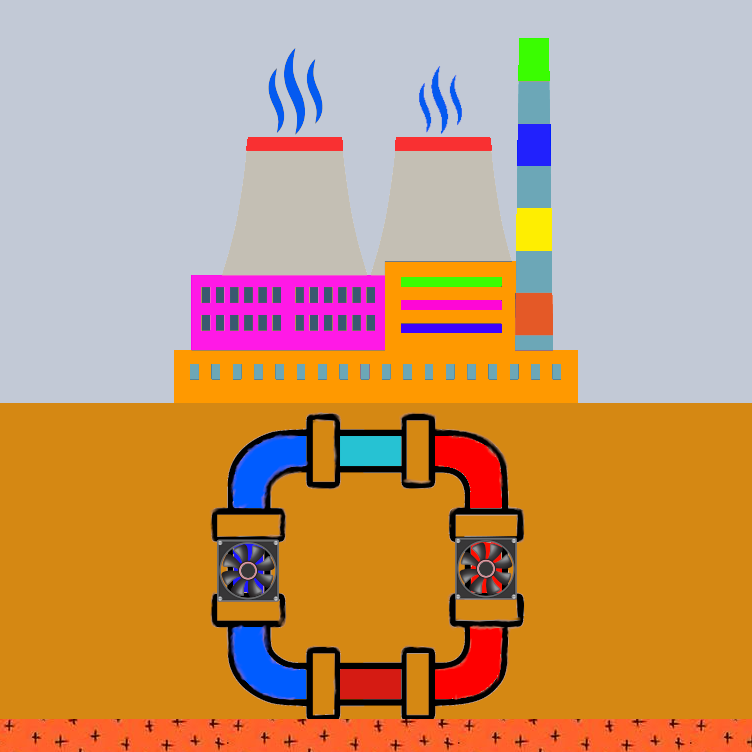
🌋 It’s easy thinking but hard to make? Well, not these times — it’s harder to inform people to do this. And indeed, it’s nearly like any nuclear power plant around. The difference? We don’t drain uranium out of its power; we use water to get warmed enough up to boil and create things like electricity. ⚛️
💧 It might be around just another particle like uranium that would generate electricity by its electrons everywhere. But that is like a fusion reactor — a reactor that gets electrons out of a particular molecule that itself produces energy.

⛏️ So perhaps there isn’t much to know, but there is this possibility that we could mine into the ground after lava, that could warm up some water. Perhaps it was never thought about — but today this was way more possible in Iceland, the northern land in the middle of the lava eruptions because of the tectonic plates. 🇮🇸
🌡️ And here is the beautiful part we want to add — the Norwegian way of gathering heat, called vannbåren varme — waterborne heating. It means using water in the bottom: water pipes laid through floors, through the ground, through the very base of a building, carrying warmth from a heat source up into everything above it. Imagine a lava-warmed water bed beneath an entire city — the lava heats the water in the bottom, and the water quietly heats everything above. No smoke, no burning, just warm water rising. That’s how Norway heats most of its homes today, and it’s exactly the technique a lava power plant would use to spread the heat. 🏠
📣 We would like to inform you about a great artist called deaLazer, who mainly works on these informative posts on this page — so surely you would want to connect more with that guy over at Twitter @Dealazer. And don’t forget ours 🙂 @InvestDiesoftly. 🎵
🎧 Now listen to his extraordinary music:
🌊 So what is the take today? We need to see all options for green energy. Did you know that the waves on the sea? They can create very much more power than windmills. So we’ve spoken about this earlier, but this is a better catch — and we want you to bring the information forward. 💨
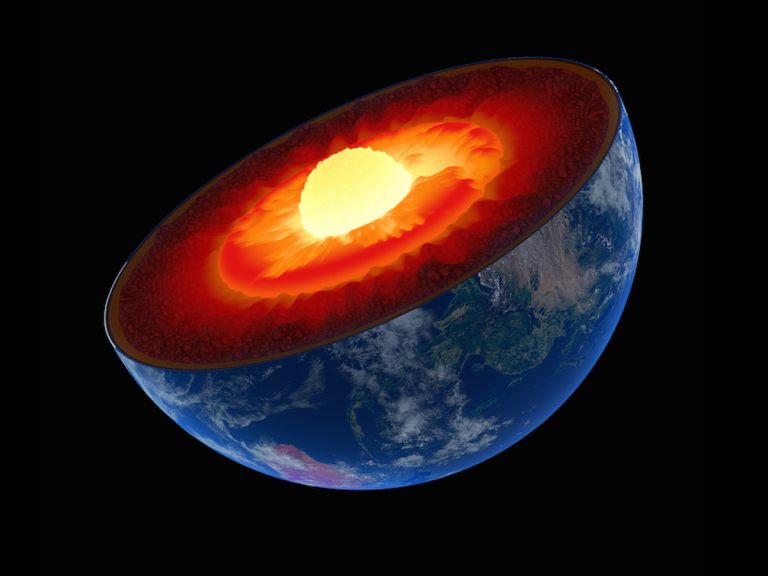
🔥 The lava often is in the crust of about 1km below. It’s possible to dig anywhere on this planet; we’ve dug earlier for up to 20km down. And if we put a lava warming solution in that ground, we will gain energy out of the turbines from water going down and going up.
🇨🇭 And here’s what the world has already tried — Switzerland almost did it before anyone else. Back in 1996, the Swiss Federal Office of Energy launched the Deep Heat Mining project in Basel: drill down about 5,000 meters, where the rock reaches roughly 200°C, pump cold water down into a fractured reservoir, and let the earth itself act as a giant heat exchanger. The hot, pressurized water would come back up, drive a turbine for about 3 MW of electricity, and the leftover heat — around 20 MW thermal — would warm the city’s buildings through district heating. A closed loop, completely CO2-free. 🌍
⚠️ Basel was stopped after a 3.4 magnitude earthquake in 2006 — the high-pressure stimulation of the rock set off tremors, and around 2,700 damage claims were processed before the project was finally cancelled in 2009. Then came St. Gallen in 2013: a new attempt at 4,450 meters, approved by 83% of voters — until a gas encounter and a 3.6 magnitude quake put it on hold. Two failures, but each one taught the world how to drill softer. 🛠️
🔬 And Switzerland didn’t give up. Geo-Energie Suisse patented a multi-stage stimulation concept — fracturing the rock in small, staggered sections instead of one massive open-hole push. Tested in the granite of the Gotthard massif, it increased permeability by a factor of 10 to 100 while the microseismicity stayed around magnitude −1.8 — about a million times smaller than Basel. That’s the breakthrough that opened the door again. 🚪
🏗️ Today, the flagship project is Haute-Sorne in the Canton of Jura — a 5 MW deep geothermal plant with construction expected towards 2028 and commissioning around 2029. The first well was drilled in 2024, and a test stimulation was successfully conducted in July 2025. New shareholders keep joining, because everyone can see it: Switzerland’s largest energy source lies directly beneath their feet. That’s the lava power plant idea — just reached from above, not from below. ⚡
🧊 So how would our lava power plant actually be built? Think of it in layers, like the Norwegian floor: first, the vannbåren varme water grid in the bottom — insulated pipes laid in a closed loop around the heat source. Second, the heat exchanger — water pumped down where it’s warmed to steam. Third, the turbines above, spinning generators with that steam. Fourth, the district heating line — because after the turbine, the water is still warm enough to heat thousands of homes, exactly like the Riehen plant near Basel has done since 1994 for thousands of inhabitants. Fifth, the cooled water returns down — a full circle, nothing wasted. ♻️
🏝️ In Iceland this already works at scale — heat from the ground warms nearly the whole country, and geothermal provides the majority of its energy. Switzerland is proving the deep version can be done safely. Norway has proven the water-in-the-bottom distribution. Put the three together, and the lava power plant is not a dream anymore — it’s an assembly of proven parts. 🧩

🤝 Why not support us in these challenging times?

🌱 With investments into the future, we will open up the doors to anyone — it’s the future that matters. A lava power plant, a vannbåren varme grid, a Swiss-patented soft drilling technique — the pieces exist. All we need is to build it, softly, deeply, and together. 🔭

Useful information